


FRENECTOMY
Difficult breastfeeding is a common frustration, with multiple potential causes, but one of the most common is the infant being unable to latch properly due to a lip tie and or a tongue tie.
What is a lip tie and a tongue tie?
Inside the mouth, there are small tissue strands, known as frena. They run between the lips and the gum or between the tongue and the base of the mouth. These frena vary in individuals in length, thickness and exact attachment points – the thicker or shorter they are, the more they limit the movement of the lip or the tongue.
Paediatricians and obstetric nurses should be checking for both of these, and in the past, have been snipped by the doctor at birth, using a little scissors. However, even though awake paediatricians have done the snip, which has reduced latching problems, they have very often failed to instruct mothers to perform little exercises around the lip or tongue which prevents the lip or tongue from healing in a position similar to the tied position. So although latching is not a problem, as with the case of these being missed at birth, the ties have consequences long term:
- A maxillary lip tie keeps the upper lip in a pulled up position, making the child less likely to close the lips at rest:
- Forming of certain letters in speech becomes more difficult – p, b, and m (bilabial sounds), and the letter w (which involves rounded lips) may be a problem for children with lip ties
- Where the frenum extends between the incisors and onto the palate, it will prevent the teeth from coming together, creating a midline diastema in the permanent set of teeth
- A lip that doesn’t close over the front teeth, leaves them more prone to dehydration as saliva doesn’t flow over them as often and this makes these teeth more prone to decay.
- In addition, without the top lift as a strong “muscle” pressing down on the front teeth, especially when accompanied by a tongue thrust, the front teeth tend to flare outwards as opposed to maintaining an upright position
- Tongue tie: The further towards the tip of the tongue the tie is, the more limited the movement of the tongue:
- This creates a flattened or square appearance when the tongue is lifted as opposed to a long oval outstretched tongueThe tied down tongue has difficulty shaping under the nipple during breat feeding, thus latching is difficult and going undiagnosed, results in a frustrated mom and baby, abandoning of the breast and turning to the bottle, and sadly leaving many moms feeling like failures (when in fact, it’s the medical personnel who have failed to pick up this common problem).
- In toddlers, tongue tie may interfere with chewing, because moving food around the mouth may be difficult.just as with lipties, a tongue tie can also cause articulation problems, The sounds “t”, “d”, “n”, and “l” are particularly affected, as they require the tongue tip to touch the alveolar ridge (the bony ridge behind the teeth). The sounds “s”, “z”, “th”, and “r” can also be challenging because they require specific tongue movements and positioning.
- The position of the tongue plays a critical role in jaw growth, palatal shape and position of the teeth – this in turn influences, face shape, aesthetics and spinal alignment.
- As with lip ties, the pattern of breathing is changed from the first year of life from nasal to oral – mouth breathing has many immediate and long-term consequences. Dr Theologides has often been invited over the last 20 years, by institutions such as Christian Barnard Netcare, Medical integrative societies and talk shows, to discuss the importance and impact of nasal breathing over moth breathing based on her 30 years in clinical practice, over 27 years as a Paediatric specialist and as an integrative and biological practitioner.
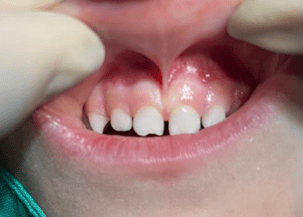
Does my infant need a frenectomy?
It is normal to see the frenulum below the tongue or inside the lip when you look in a infant’s mouth. There are two important questions to consider when deciding if a frenectomy is needed:
- Is the baby having difficulty getting enough milk? Does he/she appear frustrated? Crying a lot? Wakes up often through the night? is making large sucking noises? Isn’t gaining weight? Symptoms of reflux, colic, or both? Falls asleep or loses grip when nursing?
- Is nursing uncomfortable for mom? Chewing on, or “gumming,” the nipple when nursing? Needing to feed more frequently than normal? Mastitis or plugged ducts? Incomplete drainage of the breast? Discomfort to extreme pain when the baby tries to latch? Blistered, bruised, or cracked nipples? Blanched, flattened, or creased nipples after nursing?
If the answer to either of these questions is “yes,” then visit your paediatrician or lactation nurse or visit our office for an examination.
By the age of approximately one years old, the breathing pattern will be imprinted on the brain.

About the procedure
Laser frenectomy is typically a very straightforward, uncomplicated procedure. Dr. Theologides and her team make every effort to ensure that the procedure is as gentle as possible, regardless of age. where there may also be other dental treatment required, as with many children under the age of 10, we recommend light sedation in a clinic environment with a specialised paediatric anaesthetist. For newborns and children over 10 and adults, in chair procedures begin by ensuring mom and baby; or child/adult are comfortable and calm. Numbing gel is applied to the area to minimise any discomfort. In the case of lip ties, a little local anaesthetic is given to reduce any discomfort. The laser provides a quick release of the frena with minimal to zero bleeding.
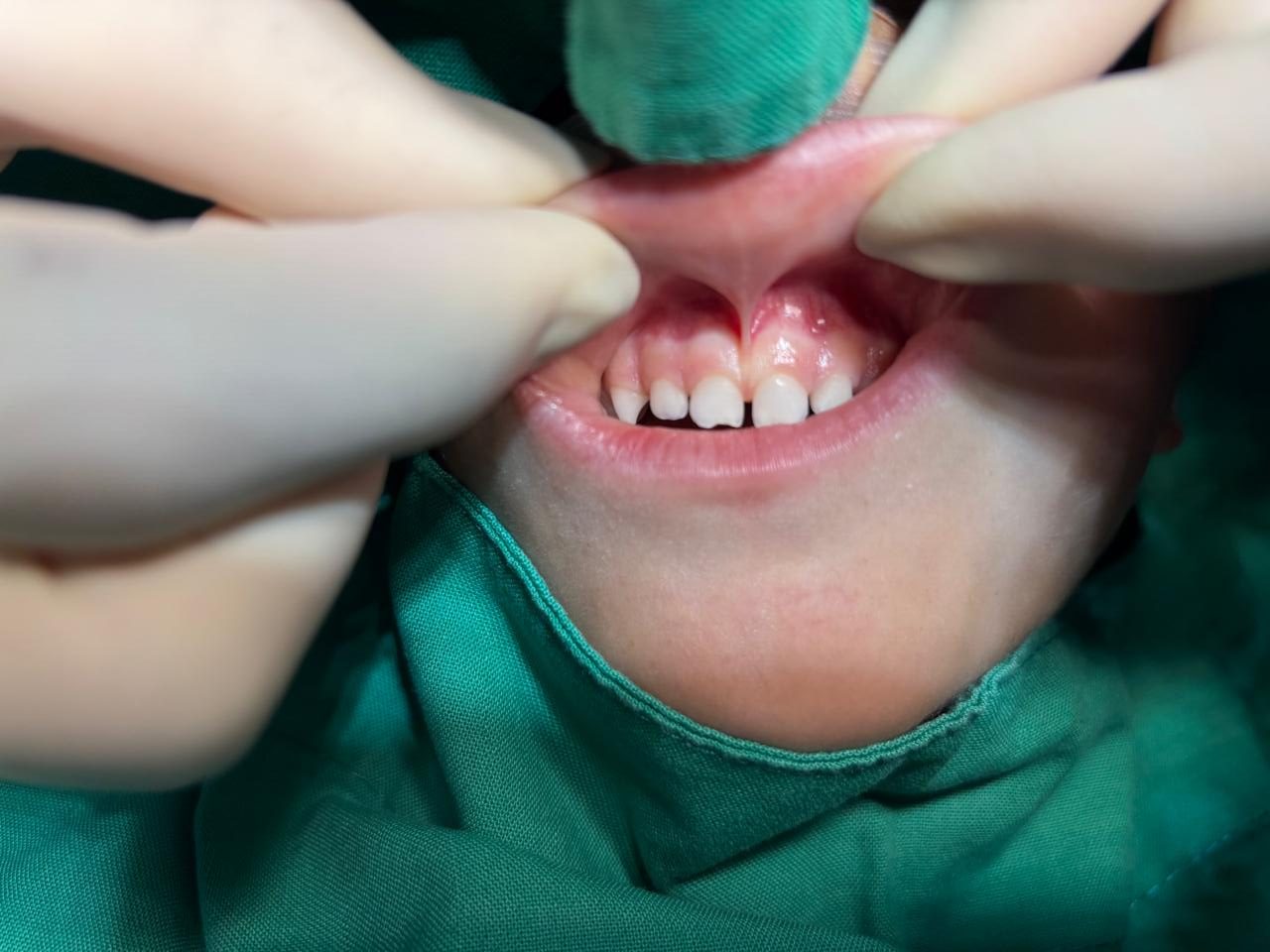
Post procedure Care
We generally apply an aloe-based gel on the area and recommend the use of salt water rinsing in older children and adults several times per day. In addition, in these older groups having a tongue tie release, we recommend the use of arnica and Traumeel to reduce any pain or swelling and accelerate healing. Infants can breast feed immediately after to help soothe them.
Doing the necessary lip and tongue exercises from day one, is vital to prevent re-attachment and to train the lip/tongue to function and position correctly. Always ensure your hands are clean.
Wrty infants: Position your baby on your lap, with his or her feet pointed toward your knees and their head toward your hips, consider playing soothing music or singing or talking softly to your baby while doing the exercises.
Over the first few days, perform the following stretches every 4-5 hours for at least three weeks. Continue for one additional week, for 2-3 times per day.
- Wrt frenectomies: Lightly hold the lip and gently sweep it from side to side, up towards the nose tip and down towards the lower lip. Perform five repetitions.
- Wrt tongue tie releases: Place both of your index fingers under the baby/child’s/self, tongue and lift upwards (not backwards) and hold for two full seconds. Use one index finger to lift and prop the tongue gently, softly massage around the diamond shape healing area in an outward direction. With children and adults, every 3-4 hours, initially by physically holding the tongue, you can use a small piece of gauze or a thin face cloth to get a better grip, pull the tongue out and down to touch the chin; up to touch the tip of the nose and from side to side “to touch the ears”. These must be done for a few minutes at a time and generally we recommend continuing with these exercises for 3 months to teach the tongue correct rest position but also normal full range of movement. Where speech issue have been a problem, seeing a speech therapist is a great way to get the correct formation of letters and words.
- Ps we often meet frustrated parents and children who have been seeing a speech therapist for years, with little to no improvement and an undiagnosed lip or tongue tie. No amount of therapy or exercises are going to correct speech difficulties if the root cause of the problem has not been addressed.
- Encourage the infant to suck your finger. Once he or she latches, have a “tug-of-war” game. This helps build strength.
Post Tongue Tie Release Instructions:
- Start today with cool and cold foods and liquids.
- Be carefull not to bite your tongue especially while still numb.
- Use mouthwash 3 times per day or saltwater an additional 3 times per day in between.
- Brush teeth normally from tonight.
- Apply Aloclair spray and Gel after rinsing each time.
- With clean hands massage area as per video each time before saltwater rinse.
- Do exercises every few hours as demonstrated to avoid re-attachment.
- Take anti-inflamatories for the first 3 days with meals and take Traumeel 3 times a day for the first 3 days and then once per day until healed.
POST-OP INSTRUCTIONS FOR INFANT TONGUE-TIE RELEASE:
Your goal is to have the frenum heal and re-form as far back as possible. You should do the stretches with the baby laying down on a bed or couch facing away from you like during the exam. There is a video on our website at www.TongueTieAL.com. Please follow-up within 7-10 days. Begin doing the stretches the DAY AFTER the procedure. Gloves (preferred) or clean hands with nails trimmed should be used for stretches.
- If the lip was revised also, first put your fingers all the way in the fold of the lip and pull the lip up and out as high as possible, so you can see the white diamond and cover the nostrils. It may bleed slightly the first day or two, this is not a concern.
- With one or two fingers, lift the tongue up and back just above the white diamond to put tension on the wound and hold for 10 seconds. It may bleed slightly the first day or two, this is not a concern.
- The main issue is to open the “diamond” all the way up on the lip and especially the tongue. If you notice it is becoming tight, then stretch a little more to open it back up.
- Repeat this ideally 6 times a day (4 minimum) (change up the time during the day).
- Repeat this for 3 weeks.
- At other times, play in your child’s mouth a few times a day with clean fingers to avoid causing an oral aversion. Tickle the lips, the gums, or allow your child to suck your finger.
- Tummy-Time as much as possible. Visit www.TummyTimeMethod.com for helpful tips.
- The released area will form a wet scab after the first day. It will appear white and soft. It may change color to yellow or even green. This is not infection, but is just a scab in the mouth. The white / yellow area will get smaller each day lengthwise, but HEALING IS STILL HAPPENING! So even though the white scab will heal you must continue stretching or the new frenum will not be as long as possible and the surgery may need to be repeated. If you have any concerns, please contact our office.
Follow up with a lactation consultant is critical if nursing. Bottle-feeding babies will benefit from visiting a feeding therapist. A bodyworker (chiropractor, CST, etc.) is also very helpful. You should expect one better feed a day (two better feeds the second day, etc.). Sometimes there’s an immediate difference in feeding, and sometimes it takes a few days. Skin to skin, warm baths, and soothing music can be very beneficial to calm the baby.
For pain make sure to give CHILDREN’S PANADO SYRUP (160mg / 5mL) starting WHEN YOU GET HOME and for the next 2-3 days every 4-6 hours. For babies who weigh 6lbs give 40mg or 1.25mL, 7lb give 1.5mL, 8lb give 1.75mL, 9lb give 2mL, 10lb give 2.25 and 11lb give 2.25mL. Babies 12-14lb can have 80mg or 2.5mL, 15-17lb give 3mL. If your child is 6mo old and 12-17lbs, you can give Infant’s Motrin (ibuprofen) at 1.25mL (50mg). If your baby is refusing to nurse or seems to be in pain, please make sure the Tylenol dose is correct.
Your child’s lip will swell up slightly that evening or the next day. It is normal and will go down after a day or two. The area will be sore for a few days, at one week look much better, and at two weeks look much better and almost normal.
If you suspect that your infant/toddler/child/spouse or self may have a tongue tie and want to have it assessed & possibly treated, please Contact us for a consultation on 0027 21 438 1710 or send us a message: https://saabp.co.za/ contact-us/
