


IS YOUR BREATHING KILLING YOU?
As a Paediatric Biological Specialist, I’ve had the privilege of watching infants & toddlers grow and blossom into young adults, and the intimate relationships built over 30 years, have allowed me to get a glimpse of their habits, their food preferences and the consequences thereof.
Watching really cute children with allergies, thumb sucking habits, or diets consisting of only “white foods” (rice, bread, pasta, chicken nuggets – no actual protein or any array of vegetables or even fruit), grow into mouth breathing teenagers and adults with attention issues, poor posture and similar elongated faces with narrow mouths and crowded teeth, has been hard for me when parents weren’t willing to make changes to their child’s habits or diet. Thankfully, in most cases, we were able to stop the predicted path, with parents who were willing to take a stand for their children, and give up pacifiers, and try functional devices and change their children’s diets.
The hard reality is that 40% of today’s population suffers from chronic nasal obstruction, and around half are habitual mouth breathers with females and children suffering the most.
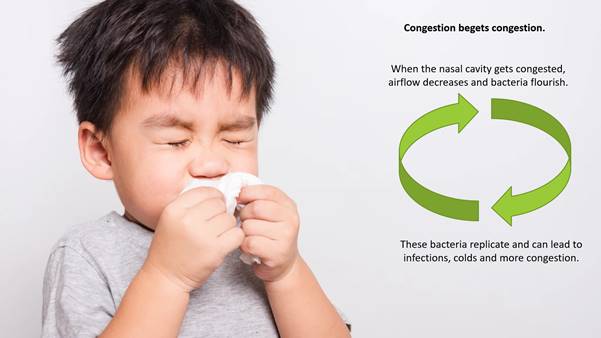
The causes are many: dry air, stress, inflammation from allergies, pollution, pharmaceuticals – but the problem is that it becomes a vicious circle between the probable original cause, the nasal passages becoming congested as air is flowing through the mouth instead of the nose, allowing for bacterial infestation, which then keeps the sinuses congested, leading to more mouth breathing and back to more congestion. Most moms tell me that their child generally breathes through their nose but due to allergies, for the last ….. years, they have been breathing through their mouth for that reason. Breaking the cycle is mandatory to allow the child to re-establish a different habit of breathing.
Why is nasal breathing important?
Your nasal passages are sinuses designed to prepare air for delivery to your lungs. They act as a humidifier, warming and moistening the air. They also remove debris and act as a first-line of defense against unfriendly microbes.
One of the most important ways that nasal breathing helps oxygen flow is via nitric oxide(NO). Nitric oxide is produced primarily in the nasal sinuses by specific enzymes.
- It’s instrumental in delivering oxygen around the body efficiently because it regulates blood flow.
- When it mixes with air delivered to the lung, it increases arterial oxygen tension and reduces blood pressure.
- Nitric oxide also has a vital role deep within your body’s cells. There, it influences platelet function, immunity and the nervous system.
- It’s also important in homeostasis & the regulation of mitochondrial function.
Nasal breathing alone can boost Nitric Oxide sixfold,
Allowing us to absorb 18% more oxygen than breathing through the mouth.
In contrast, mouth breathing provides none of the air-warming and humidifying properties of nasal breathing. It delivers no nitric oxide. Mouth breathers have a lower oxygen concentration in their blood; low oxygen concentration in the blood has been associated with high blood pressure and cardiac failures. In humans, it’s really just a survival mechanism, to be used when the nasal breathing is impossible.
I’m also often told by parents that mouth breathing and the child’s face and jaw structure is genetic; “dad and grandpa have the same issues”. But as a functional medicine practitioner, I know that genes are only 5% of any condition, the rest is about epigenetics: genetics are expressed according to the functional demands. In other words, genetics, are in fact, guided by function/environment, which leads craniofacial growth and development.
We know this is true when we look at studies done on identical twins, where the one develops an allergy to a pet for example and the switch to mouth breathing due to the congested nasal passages, results in a complete transformation of the face and jaws, as a cascade of events takes place:
- Mouth breathing results in repositioning of the tongue, resulting in a low resting position to allow oral airflow
- decreased use of nasal passages, results in underdeveloped sinuses
- less pressure from the sinuses plus, low tongue position plus airflow results in high arched palate
- narrow jaws
- less space for the teeth, so crowding
- the face becomes long and the eyes appear droopy
- Spinal alignment changes as head and neck position change.
But what’s the root cause in most cases?
Most parents are not aware that oral habits like mouth breathing, non-nutritive sucking habits (e.g. thumb sucking, finger sucking, dummy sucking and tongue sucking) affect tongue posture inside the mouth.
The other effectors: tongue-tie and lip-tie. Link to lip tie and tongue tie section
Dr Maria Theologides is often invited to present on this topic is your breathing killing you?
In the last few decades the medical and dental professions have become more aware of Sleep Disordered Breathing (SDB) acting as a major contributor to a range of health problems.
In addition to having a negative impact the following day on mood, energy levels, ability to regulate stress, behavioural problems and emotional well being, we now understand that chronic sleep disturbances have a profound impact on our body’s ability to heal and repair, our immune system, our cognitive abilities, our metabolism and our life span.
SDB characteristically occurs when either due to an obstruction in the nasal passages or habit, the flow of air is through mouth instead of through the nose. Added onto this, there is airflow obstruction orally, typically caused by relaxation and poor muscle tone around the throat and jaws, or/and the dropping backwards of the tongue, obstructing airflow.
The most common of these are habitual chronic mouth breathing, poor diet, obesity, poor development of the jaws, and tongue ties. Additionally, where orthodontics have been accompanied with extractions, this can exacerbate breathing issues.
In the mouth breather, when the airway is obstructed by the backward positioning of the tongue, the brain sends a signal to the lower jaw to move forward to move the tongue forward and allow air to flow through the back of the mouth – this forward and backward action, in an attempt to get oxygen in, results in the grinding facets so often present in people with SDBs. Also typical tell-tell signs, are the buccal grooves and the scalloping of the tongue sides where the tongue pushing up against the teeth in its forward drive.
Traditionally treatment for SDB, particularly obstructive sleep apnoea has involved the use of a Continuous Air Pressure (CPAP) device. However, the frustration caused by the bulky CPAP machine with all its pipes, discourages many patients from using their machine.
As a result, treatment with intra-oral appliances is now considered to be the most convenient way to alleviate SDB.
Contact us to find out more about the slick intra-oral device designed by Dr Maria Theologides which can help you reduce clenching and grinding, cracks in the teeth, and repositioning of the lower jaw to reduce obstruction of the airways.
